Learning Showcase
Global Leadership Café
A volunteer leadership laboratory in Tokyo, 2013 to 2021
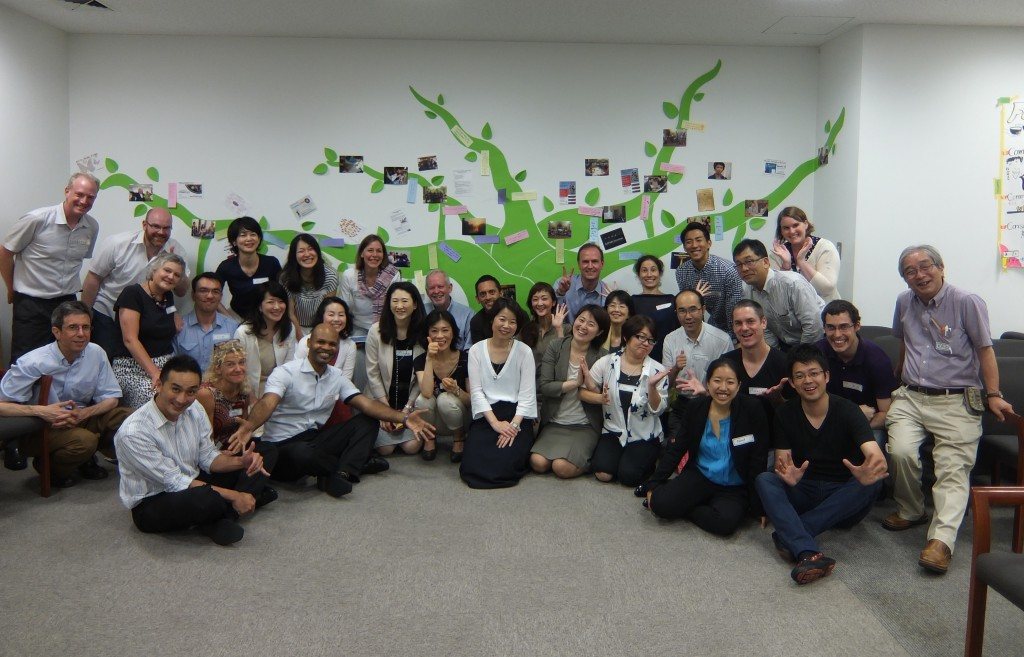
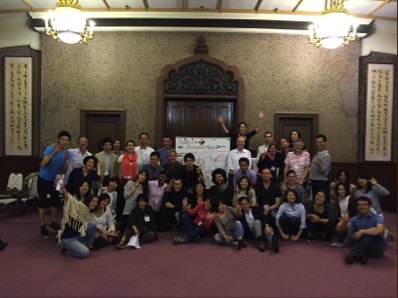
Before I was designing leadership programs inside a company, I was helping run them for free, in the evenings, for whoever showed up. The Global Leadership Café was a self-organizing community that put forty strangers around ten tables and gave them one question about leadership to work through together. I was one of its co-creators: I co-led the planning team of ten coaches that designed each evening, facilitated at the cafés, and co-hosted the thirteenth. This page is what it was and what I took from it.
- My role
- Co-creator; co-led the planning team of ten coaches; facilitator and co-host
- Format
- World Café evenings: ten tables, one question, three rounds, a harvest
- Scale
- Fourteen cafés plus two Future of Leadership forums; up to 40 people a night, more than 300 in all
- Where
- Wesley Center, Tsukiji Honganji Temple and Impact Hub Tokyo
What it was
The Global Leadership Community was a leadership learning laboratory in Tokyo, started in May 2013 by executive coach Michael Shell out of his practice, Global Leadership Partners Asia. Its stated purpose was to grow a diverse community of self-aware, purpose-driven leaders and to evolve how leadership gets developed, and its method was conversation: regular evenings that generated ideas and drew on the collective intelligence of whoever was in the room. The café was the evening itself.
The first one, in July 2013, turned a familiar complaint on its head. Instead of asking what was wrong with leadership in Japan, it asked what Japan’s unique contribution to global leadership might be. The room was HR people, finance people, coaches, artists and MBA students, and the conversation followed them out into the street afterward. There was never a question about holding a second one.
What made it unusual was how it was run. Nobody was in charge. A volunteer leadership body planned each evening in open meetings that anyone could join, starting with a check-in and borrowing its working rules from sociocracy, holacracy, nonviolent communication and deep democracy. A member described the result better than I can:
“We have created a safe place in Tokyo for anyone to join and be accepted.” A community member, quoted on the café’s site, 2014
One evening on film
The community’s first video, shot at the third café, Freedom to Fail, in February 2014. It shows the format better than any description: the tables, the rounds, the wall, and the room at work.
Guiding principles
The working rules settled over the years into seven principles, each with a practice attached. This is the form Michael Shell set down for the group in January 2021:
- Effortless effortWork from choice, in line with your values.
- There’s nothing to fixRespond to life as it arrives, not as it ought to be.
- Assume best intentionsRead other people’s actions as meant for the greater good.
- Every voice mattersListen to every voice, spoken or unspoken.
- Listen for emergenceEnter conversations curious, listening for what wants to arise.
- Distributed leadershipHelp everyone’s best qualities show, and match accountabilities to each leader’s challenge.
- Playfulness, experimentation and life-long learningStay willing to try things and look foolish.
How an evening ran
Every café followed the same bones, which is what made it possible for a rotating group of volunteers to host one every few months without a professional crew.
- A jolt Something physical to get people out of their workday before anyone talked: pairs sculpting the same lump of playdough toward two secret shapes, a mirroring game where leading and following swapped mid-movement, a wall where everyone posted a failure of their own.
- Three rounds of one question Tables of four or five worked a single question, then scattered to new tables and carried the last conversation into the next one. The questions were chosen weeks earlier in the planning meetings and sometimes voted on by future participants.
- The harvest Insights went up on the wall on large sticky notes and were grouped into themes on the spot. By the last café they were sorted as head, heart and hand: what we think, what we feel, what we will do.
- One commitment each Everyone left with a single action they had named out loud, sometimes with a coach’s help. At the tenth café those went onto a paper banyan tree.
The fourteen conversations
Each café had a theme and, usually, a write-up by one of the volunteers. Open a title for a short summary, a photo, and a link to a full account of the session (where available). The badges mark the evenings where my name was on the facilitator or host list.
-
1 Jul 2013
The founding evening at the Wesley Foundation.
The founding question flipped the usual complaint about leadership in Japan into an asset: what does Japan bring to global leadership that nobody else does? The room mixed HR, finance, coaching, art and business school, most of them strangers to each other, and it was the first run of the World Café format that every later evening used. The detail everyone remembered is that the conversation carried on out of the building and into the street.
No photo of this evening survived in the archive. The Facebook event sets the date as Monday 1 July 2013. Source: the community’s own account
-
29 Nov 2013
Thirty-three people. The topic of time kept surfacing, and became the theme two cafés later.
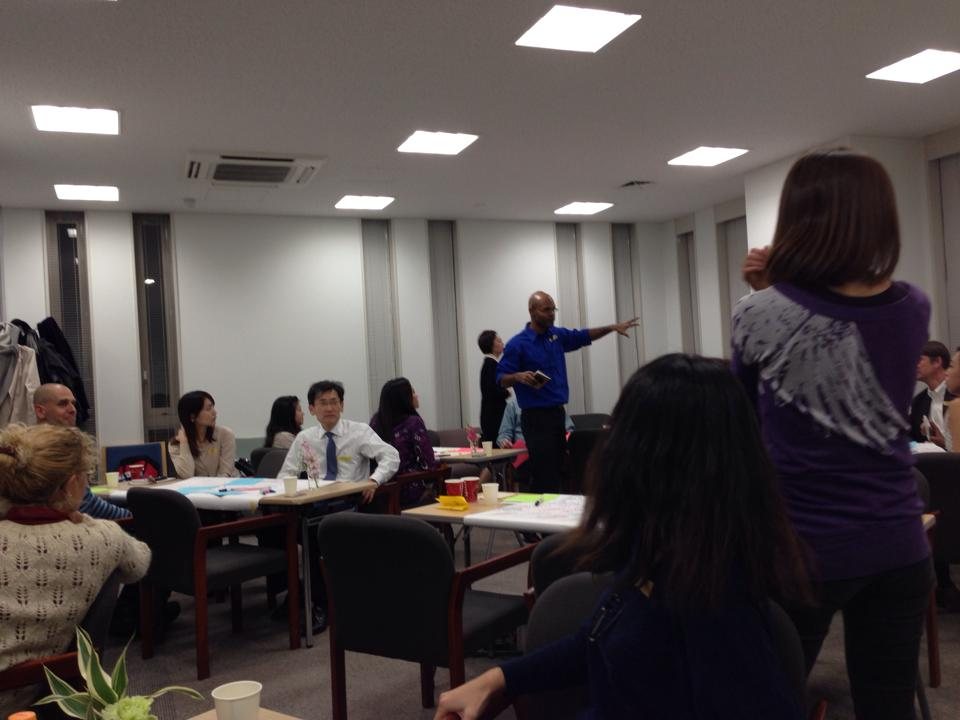
The Wesley Center, 29 November 2013 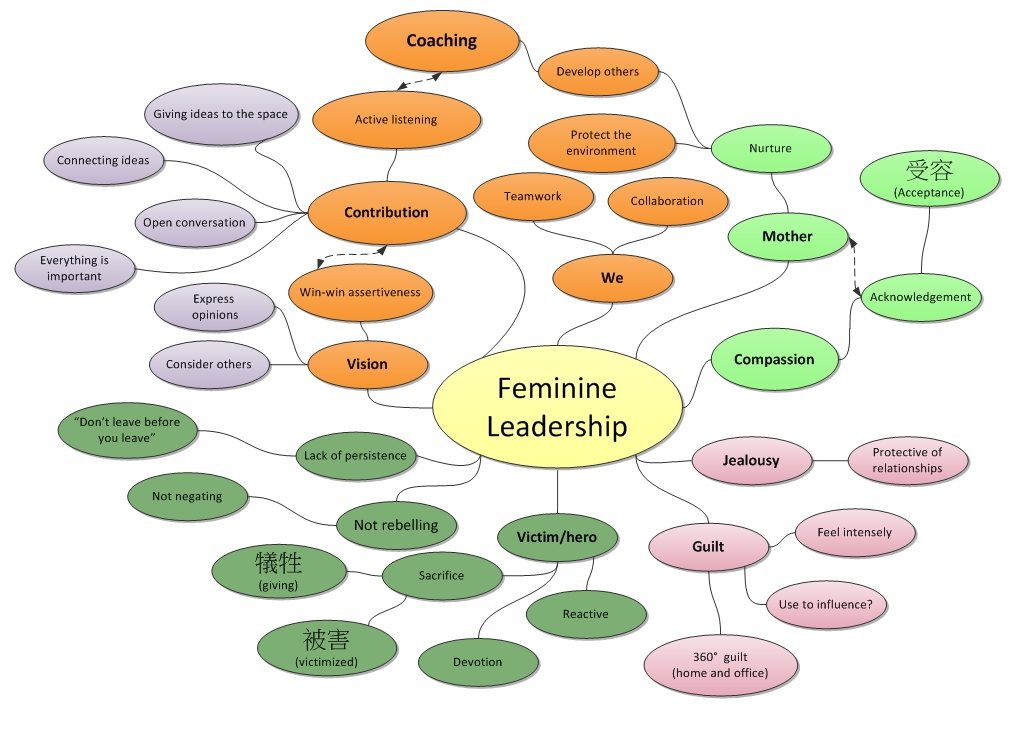
The organizers’ mind map, drawn a month before Fifty seats, a 3,000-yen door fee, and the Wesley Center again. A month earlier five organizers met, drew a mind map of their own views, published it, and opened a comment thread so readers could argue with it. Thirty-three people came. The review afterward says the evening skipped the expected fights about quotas and blame and landed instead on listening, compassionate assertiveness and seeing the whole; at one table the subject of time came up so often that it became the fourth café.
Source: Michael Shell’s review and David Nevin’s mind-map post
-
7 Feb 2014
Sold out. Opened with a failure wall; five questions across ten tables instead of one.
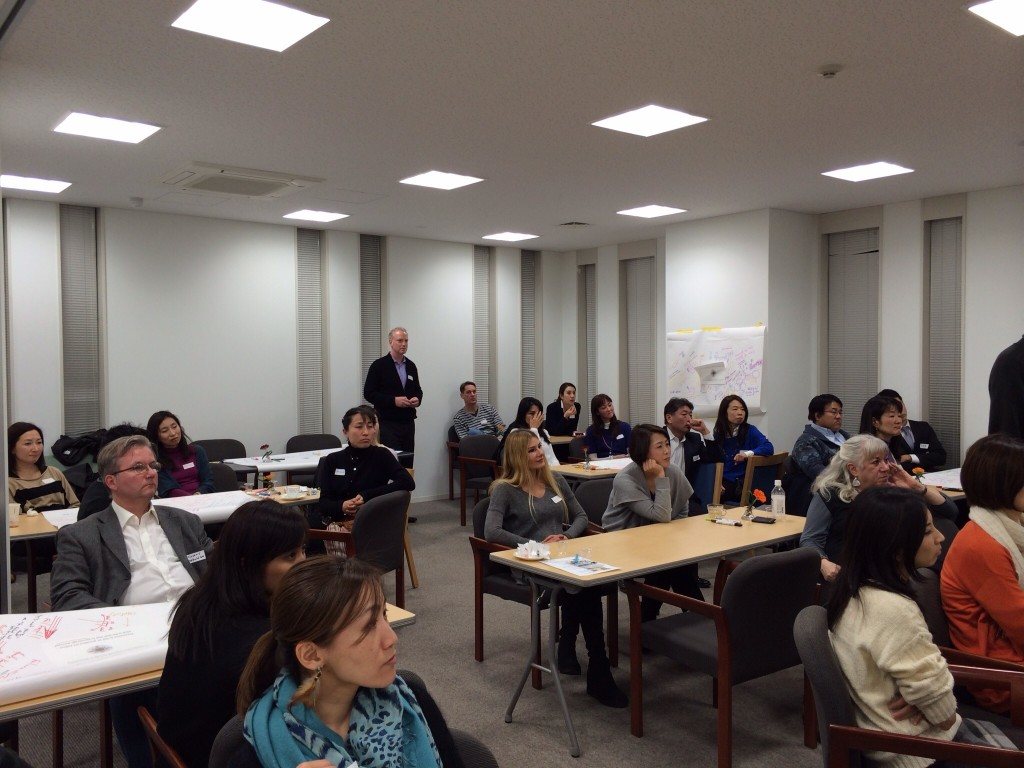
7 February 2014 The organizers thought out loud for weeks beforehand: a post on why children try things and adults over-plan, a collection of quotes on failure that a reader answered with a bilingual list of her own, and a pointer to a Nikkei interview on entrepreneurs. About thirty-five people came and the night sold out. Everyone pinned a failure of their own to a wall on the way in; the tables carried five different questions rather than one, so moving meant a new question as well as new faces. The review calls it life-changing for at least one person, and the comment thread turns it into a harder question about whether organizations actually give people permission to fail.
Source: Aruna Byers’ review and the community’s next-day report
-
18 Apr 2014
A time wall on the way in, and a coach at the end to turn insight into an action.
The image used to announce the theme Announced in February, with the candidate questions published for a vote: how much spaciousness you have as a leader, how you match other people’s rhythms, whether time is really money. Arrivals wrote their first thoughts on a time wall. Three rounds later the harvest sorted into five themes, values, habits, perception, stopping and natural time, and each person picked one and, with a coach alongside, named a single change to make.
Source: Aruna Byers’ review
-
26 Jun 2014
At Tsukiji Honganji Temple. Playdough, then a line across the room from “relish it” to “avoid it.”
The artwork used for the announcement The first café at the temple, which became a regular home. Pairs were handed one lump of playdough and two secret shapes to make from it, which produced conflict on demand; then everyone stood on a line across the room according to how they felt about conflict in general. Three questions followed: what it is, what it can create, and how to invite the creative kind. By the close several people who had stood at the avoiding end said their attitude had moved, and a recent graduate’s comment under the post is the warmest testimonial the site has.
Source: Aruna Byers’ summary
-
3 Oct 2014
Marshmallows, spaghetti and the court jester as a model for challenging the status quo safely.
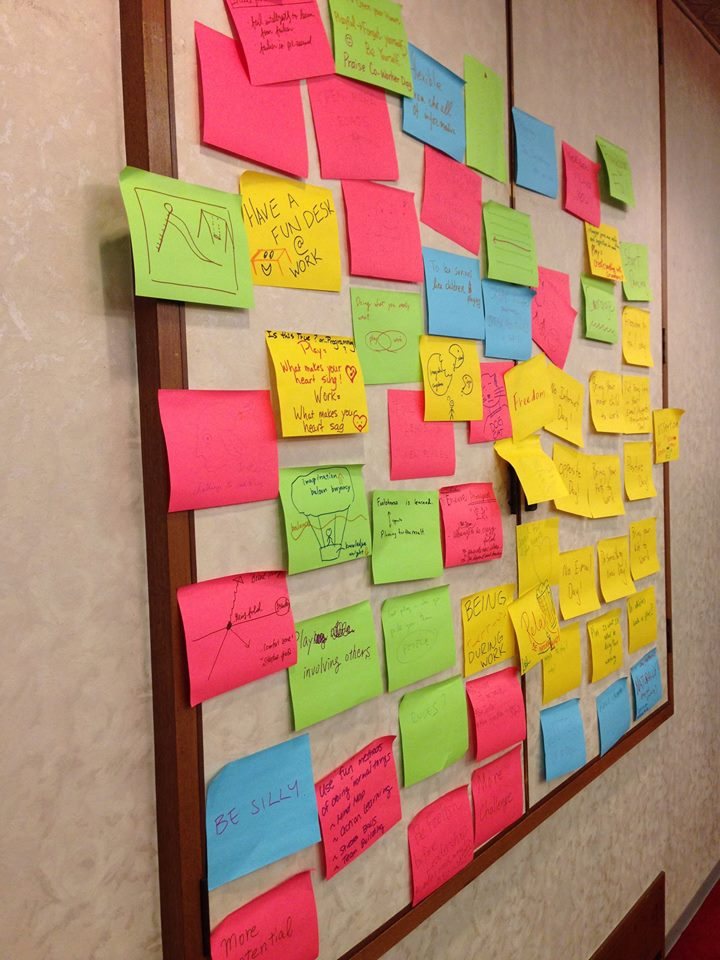
The harvest wall 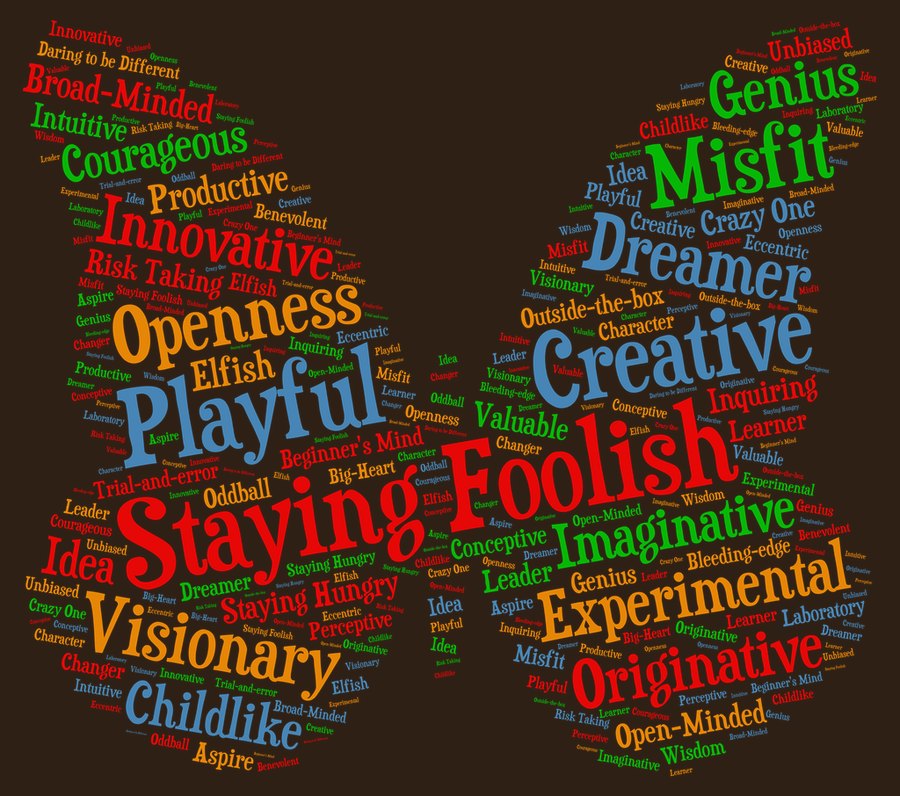
The theme image Back at the temple, with a marshmallow-and-spaghetti build to loosen everyone up. The tables kept returning to the court jester, the one person who could challenge the king and get away with it, and to the question of why it takes courage to bring play into an office. The practical ideas that came out ran from a playful week to a deliberate dose of surprise at work. The mix was notable: first-timers and regulars, Japanese and not, in roughly equal measure.
Source: Michael Shell’s write-up
-
28 Nov 2014
Forty people. The write-up distilled seven conditions for collaboration, among them trust, alignment and a safe environment.
Two open planning meetings, at the Wesley Center and at the temple, narrowed the evening to two questions: when have you experienced great collaboration, and how do you encourage it on purpose. A mirroring game opened the night, with leader and follower swapping mid-movement, before the tables took over. Everyone left with one small step to take in their own organization. The summary was co-written by Michael Shell and Annette Karseras, and Michael’s later comment on it turned the notes into seven conditions for collaboration.
No usable photo survived. Source: the summary by Michael Shell and Annette Karseras
-
6 Feb 2015
Breathing and posture as leadership tools, with the invitation published in Japanese as well as English.
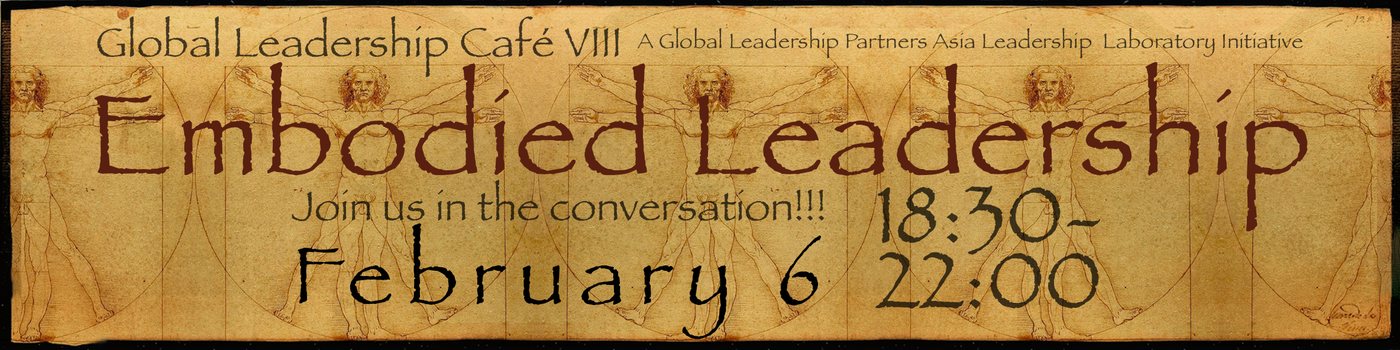
The event banner Forty-plus people at the Wesley Center. Two normal rounds of conversation, then the evening turned experimental: attention to breathing and posture as a way of carrying a chosen leadership quality in the body rather than just naming it, and a closing loop in which participants critiqued the format itself. Seven volunteers facilitated in sequence, and for this café the invitation went out in Japanese too.
Source: Annette Karseras’ report
-
10 Apr 2015
Opened by asking everyone to count the communities they belonged to. Answers ran from 4 to 63.
About forty people at the temple on a cold spring night. The opening task was to write down how many organizations and communities you belong to; the numbers kept being crossed out and raised as people reminded each other of alumni groups, membership cards and shared interests. Four questions then moved from being empowered by a community to empowering one. The write-up is as much about the volunteer facilitators stretching past their comfort as about the participants, which is in keeping with how the community saw itself: a leadership school with no teachers.
No photo survived. Source: Annette Karseras’ report
-
2 Jul 2015
The second anniversary. Paired appreciation exercises, then a tree of commitments.
The room on 2 July 2015, in front of the appreciation tree The second anniversary opened with a recap of the nine earlier themes, each spoken by someone who had been in the room for it. Two paired exercises carried the evening: appreciating a stranger out loud, then asking for the appreciation you wanted in your own words and hearing it said back to you. Two questions followed, about going without appreciation and about bringing it into a workplace. Everyone wrote one action and pinned it to a paper banyan tree. The facilitators were Yuka Kojima, Michael Shell, David Nevin, Jorge Chiu and me; Jorge wrote it up.
Source: Jorge Chiu’s report
-
Oct 2015 to Feb 2016
The community kept meeting but stopped counting for a season.
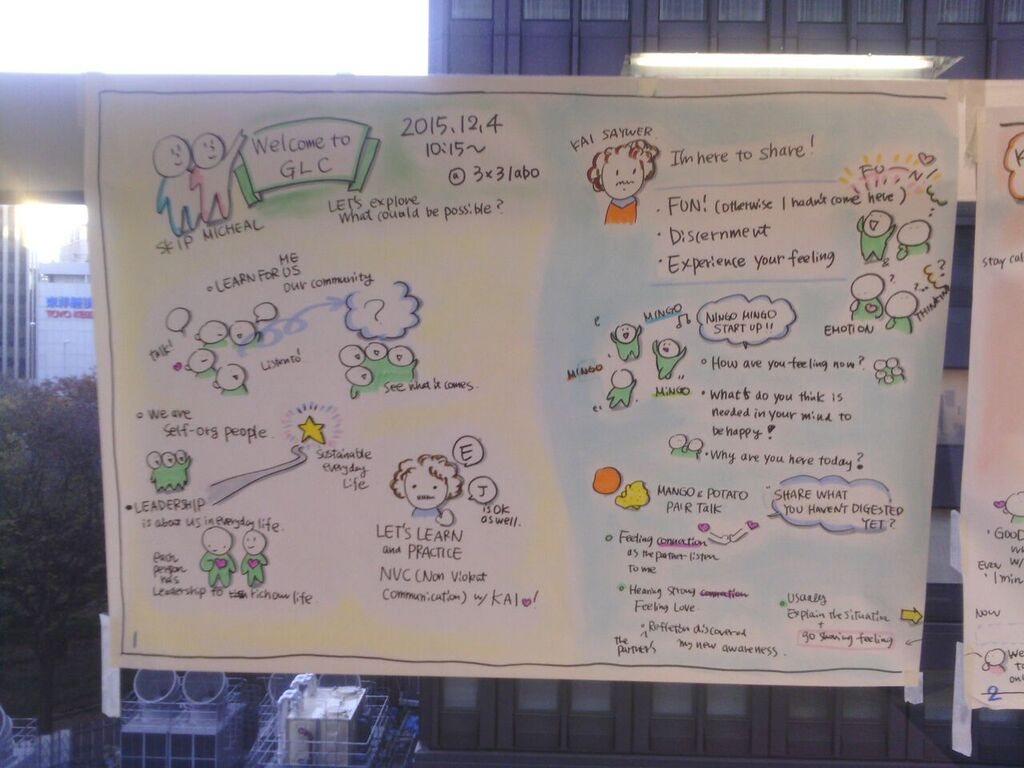
No event ever carried the number eleven. Between the tenth café and the twelfth the group’s Facebook events show four evenings billed as “GLC presents” or run with a partner instead: a Thrivable World Quest on membership and belonging with Dori Yanagi on 7 October 2015; a bilingual café on the power of the World Café itself on 21 October, marking the method’s twentieth anniversary with the International Association of Facilitators and a guest from the World Café Community Foundation; a leadership laboratory called Movement: Anatomy of Organizations on 20 November at the Hanzomon Building, which used physical exercises to explore how the parts of an organization align with the whole and drew 42 responses; and the Kai Sawyer workshop on nonviolent communication on 4 December. A talk on mindful leadership on 22 February 2016 then led into the twelfth café.
Source: the group’s Facebook events for 21 October and 20 November 2015
-
11 Mar 2016
Held on the fifth anniversary of the 2011 earthquake.
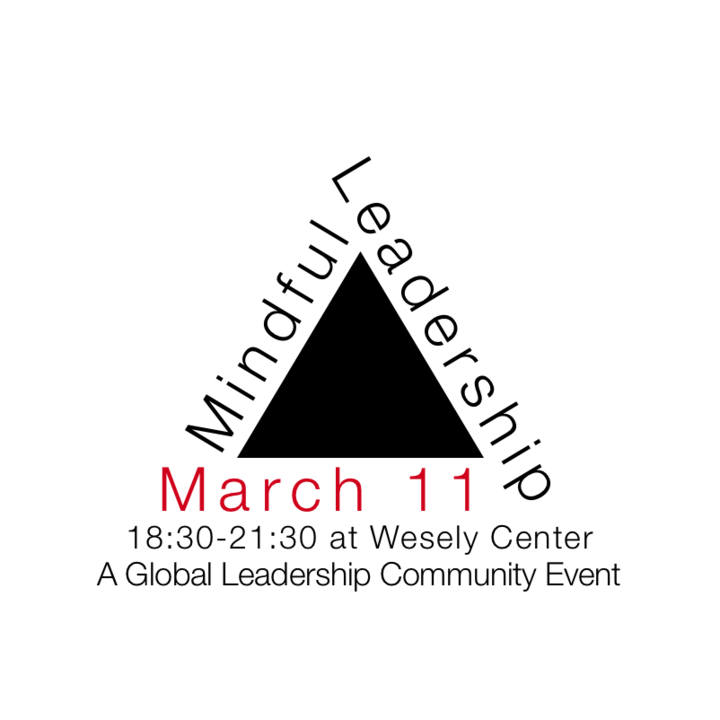
The flyer Only the invitation survives on the site: an evening at the Wesley Center asking what mindful leadership is, how anyone keeps it in a world that keeps speeding up, and what its absence feels like from the receiving end. The date was chosen deliberately. The Facebook event shows the biggest response of any café, 64 people, with a warm-up talk on the same theme on 22 February.
-
16 Jun 2016
At Impact Hub Tokyo. Six taped-out spaces on the floor for where you direct care at work; “listen” showed up in every harvest category.
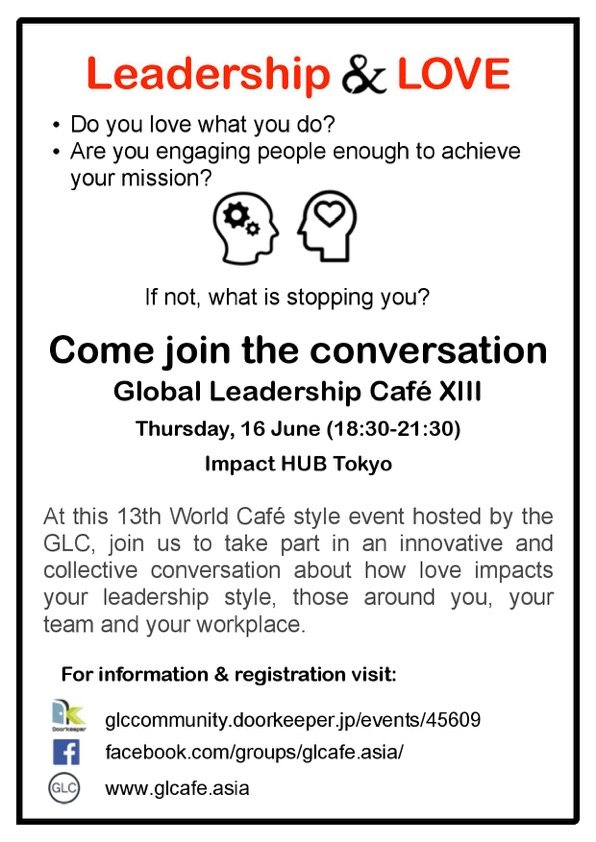
The flyer A new venue and a visual agenda drawn as a clock face by Jacob Erlich, who set the room. The opening exercise taped six zones onto the floor for where you direct care at work, customers, peers, reports, suppliers, yourself and a wildcard, and a surprising number of people chose their boss for the wildcard. Three questions and a harvest in three columns, head, heart and hand, followed; the one word that appeared in all three was “listen.” The Facebook event lists Michael Shell and me as hosts, with 38 responses. This was the last café the website recorded; its photos were never captured, only the flyer.
Source: the community’s report
-
2 Dec 2016
Back at the Wesley Center, three weeks after the US election. The last numbered café.
The website never recorded this one; the Facebook event did. Hosted by Michael Shell at the Wesley Center on a Friday evening, it took the November 2016 US election as its starting point, treating it as one more structure coming apart and asking how to build engaged communities, at work or in life, where people help each other reach their potential. Thirty-two people responded. It was the last café to carry a number; after it the group shared partner events through 2017 and went quiet until a first online World Café in January 2021.
No write-up survived. Source: the Facebook event
Hover, tap or press Enter on a title to open its summary. Each source link opens the original post in the recovered blog.
Beyond the café
The same volunteers took the format further afield. In May 2014 and again in May 2015 the community co-hosted a full-day Future of Leadership Forum, the first at the Nippon Foundation with Lynne Twist, the second with Hide Enomoto and Yoko Ishikura on the panel. In February 2015 a small team of facilitators traveled to the Thai-Burma border to run a café for the Karenni Social Development Center, a school that trains young refugees as advocates for nonviolent change. In December 2015 the community hosted Kai Sawyer for a day on nonviolent communication, run on a gift-economy basis with a potluck lunch. And in May 2016, with the International Coaching Federation’s Jakarta chapter, the community held its third event outside Japan; it sold out. The group’s last gathering came more than four years later, on Coming of Age Day in January 2021, when Chris Clayton ran its first ever online World Café, on leadership in times of transition.
What I took from it
Most of what I now do by instinct when I design a program, I first did badly and then better in a borrowed room in Tokyo with no budget.
Design the question, not the answer
The planning meetings spent most of their time on one thing: finding a question people would want to stay in. When the question was right, forty strangers needed no managing. That is still the first thing I look at in any program.
Harvest or it didn’t happen
A good conversation evaporates. Head, heart and hand gave every evening a written residue and gave each person one commitment to carry out. The measurement work in my later programs starts from the same habit.
Distributed leadership is a practice, not a slogan
Nobody owned the café, which meant everybody had to. I learned how to hold a room, hand it to someone else, and let the format carry the weight instead of a personality.
Where this comes from
Everything on this page comes from the community’s own write-ups, recovered from archived copies of the site and written by members of the leadership body. (The original community’s site is gone; but much of the content survives through the links in this archive.)
- Facebook groupStill open, with 875 members and the community’s statement of purpose.
- The group’s events listAll 36 events from July 2013 to May 2021, with dates, hosts and turnout.
- GLC Guiding PrinciplesMichael Shell’s post to the group, 18 January 2021, with the discussion under it.
- Doorkeeper event listWhere the café took registrations from 2015 on.
- GLC YouTube channelShort videos made by community members in 2015.
- Global Leadership Partners AsiaThe coaching practice that seeded the community.
The same instincts, ten years on and inside a company: Women2Lead is the program where designing the question and harvesting the answer became a nine-month journey.
See Women2Lead All of the showcaseWritten by Gordon Gaul from the community’s archived records