Learning Showcase

← Back to home

Learning Showcase

Active Listening Refresher

An interactive review and testing tool I designed and built in Articulate 360. It gives leaders a structured way to revisit, practice, and check their active listening skills a few weeks after a live learning session, when the real habit forming happens.

Try the interactive course
My role
Instructional design and development
Tool
Articulate 360
Audience
People leaders and managers
Format
Self-paced refresher, 2–4 weeks after the live session

The need

Engagement feedback, inefficient meetings, and delayed escalation all pointed to the same root cause: leaders were listening to respond, not to understand. When people feel unheard, they stop raising risks early and disengage from decisions, and execution suffers even when the strategy is sound.

A live workshop introduces the skill, but one session rarely changes behavior on its own. This refresher closes that gap. It brings participants back to the material after the session has had time to settle, so they can practice the behaviors and confirm what stuck.

How it was designed

  1. Analysis Organizational signals (engagement data, meeting patterns, escalation delays) identified inconsistent active listening as the underlying gap.
  2. Design Active listening was defined as a foundational leadership capability, with objectives focused on listening before responding, validating concerns, and creating psychological safety.
  3. Development I built a practice-based module with scenarios, job aids, and reflection tools, plus this refresher for spaced reinforcement.
  4. Implementation Delivered through leadership communication programs, onboarding, and manager development, reinforced with pre-work, breakout practice, and follow-up activities.
  5. Evaluation Mindset and behavior change measured through pre/post reflection, a 30-day pulse, and observed improvements in communication and escalation.

Where it fits

The refresher supports one session of Communication for Leaders, a 10-session course I designed for people leaders, managers, and senior professionals. Sessions run 45 to 60 minutes, practice-based and discussion-driven, and build toward clearer communication, stronger psychological safety, and more confidence in difficult conversations.

  1. Foundations of Leader Communication
  2. Self-Awareness & Communication Style
  3. Active Listening for LeadersThis sample
  4. Asking Better Questions
  5. Communicating with Clarity & Intent
  6. Giving Feedback That Builds Performance
  7. Receiving Feedback & Managing Defensiveness
  8. Difficult Conversations & Conflict
  9. Communicating During Change & Uncertainty
  10. Integration & Personal Communication Action Plan
Diagram of five levels of listening arranged in a circle: passive listening, listening for knowledge, active listening, listening for clarification, and empathetic listening
Active listening sits within a wider range of listening levels covered in the session.

The learning journey around it

Each participant’s engagement starts before the session: a welcome email frames the topic, and a short questionnaire asks them to reflect on real conversations from their own work. The live virtual session then covers why listening shapes decisions and trust, what active listening looks like for leaders, and a breakout on listening without defending, and participants leave with a one-page reference sheet. Two to four weeks later, this refresher brings the content back for practice and testing, the point where a concept either becomes a habit or fades.

Inside the refresher

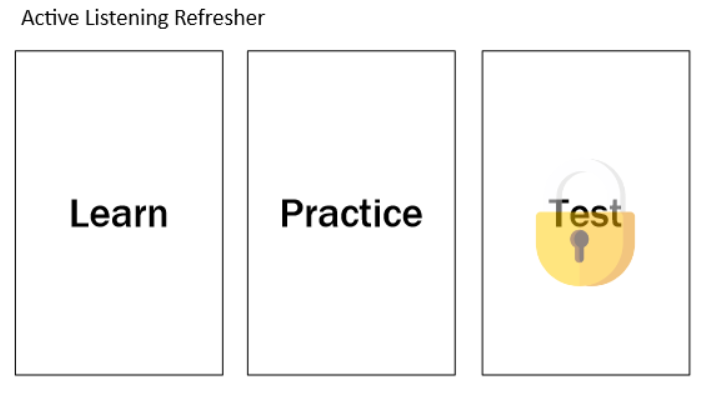
The tool is organized into three parts. Learn revisits the core content in short tabbed lessons. Practice asks participants to apply it, for example by matching each active listening principle to what it looks like in conversation. Test stays locked until the first two parts are complete, then checks retention with scored questions. Completion can feed digital badges or certificates through an LMS, which keeps engagement going well past the session itself.

Course home screen with three sections: Learn, Practice, and a locked Test section
The home menu. Test unlocks after Learn and Practice.
Learn screen with tabs covering why active listening matters, what it means, five core skills, common listening traps, and applying active listening
Learn: tabbed lessons on the why, the core skills, and common traps.
Practice activity asking the learner to match five active listening principles to their descriptions
Practice: matching principles to real conversational behaviors.
Test question asking why active listening improves execution, with the answer 'reduces rework and resistance' selected
Test: scored questions that check understanding, not recall alone.

The best way to evaluate it is to click through it yourself. The course opens right here on this site and takes about five minutes.

Try the interactive course

Designed and built by Gordon Gaul · Illustrations in the course are from Storyset

gordon.l.gaul@gmail.com · linkedin.com/in/gordongaul